|
|
|
|
|
 |
|
|
|
|
|
|
|
|
Robert the Bruce
Scottish Historical Prints  Robert the Bruce Robert the Bruce |
|
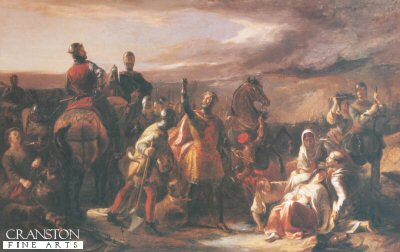
Robert The Bruce in Scottish historical art prints of Robert The Bruce, King of the Scots at the Battle of Bannockburn. Military art prints published by Cranston Fine Arts. On Palm Sunday 1306 Robert the Bruce raised the Royal Standard at Scone and in the presence of the Bishop of Glasgow, Moray and St. Andrews was crowned King of Scots. By early 1309 Robert the Bruce controlled most of Scotland north of the Forth and Clyde. In the year of 1311 he invaded the North of England sacking Durham and Hartlepool and over the following three years conquered the English garrisons of Perth, Dundee, Roxborough, Dumfries and Edinburgh leaving only Stirling in English hands. On June 24th 1314 Robert the Bruce defeated the English army under King Edward at the battle of Bannockburn. The war dragged on until the peace treaty was signed in 1328 recognising Bruce as King Robert I and Scotland as an independent Kingdom. Robert the Bruce died in 1329. With the full might of England's army gathered before the besieged Stirling Castle, Edward II Plantagenate is confident of victory. To the west of Bannockburn, Robert Bruce, King of Scots, kneels to pray with his men and commends his soul to God. Patiently awaiting the coming onslaught in tightly packed schiltroms, his spearmen and archers are well prepared for battle. Unknown to the English, the open marsh of no man's land conceals hidden pits and calthrops, major obstacles for any mounted charge. Despite Clifford's and Beaumont's premature and unsuccessful attempt to relieve Stirling the day before, years of victory have caused the brave English knights to regard their Scottish foes with contempt. So, without waiting for the 'flower of the forest' (archers) to weaken the enemy formations, the order is hurriedly given to attack! With one rush, hundreds of mounted knights led by the impetuous Earl of Gloucester, thunder headlong through the boggy ground straight for the impenetrable mass of spears, hurling themselves into defeat and death. With dash and courage the knights try to force a way through but the infantry stand firm. There is no room to manoeuvre. Everywhere horses and men crash to the ground. Casualties amongst the English nobility are horrific. Bruce seizes the moment and orders the exultant army to advance. The English recoil and are pushed back into the waters of the Bannockburn where many perish in the crush to escape the deadly melee. Edward II, his army destroyed, flees with his bodyguard for the safety of the castle but is refused refuge and has to fight his way south to England. For Robert Bruce and Scotland, victory is complete. |
| |||||||||||||||||||||||||||||||||||||||||||||||||||||||||||||||||||||||||||||||||||||||||||||||||||||||||||||||||||||||||||||||||||||||||||||||||||||||||||||||||||||||||||||||||||||||||||||||||||||||||||||||||||||||||||||||||||||||||||||||||||||||||||||||||||||||||||||||||||||||||||||||||||||||||||||||||||||||||||||||||||||||||||||||||||||||||||||||||||||||||||
|
Contact Details |
|
Sign Up To Our Newsletter!
This website is owned by Cranston Fine Arts. Torwood House, Torwoodhill Road, Rhu, Helensburgh, Scotland, G848LE Contact: Tel: (+44) (0) 1436 820269. Email: cranstonorders -at- outlook.com |
|
|